Frequently Asked Questions
Factored
Monitoring Machine Learning Models
About This Course
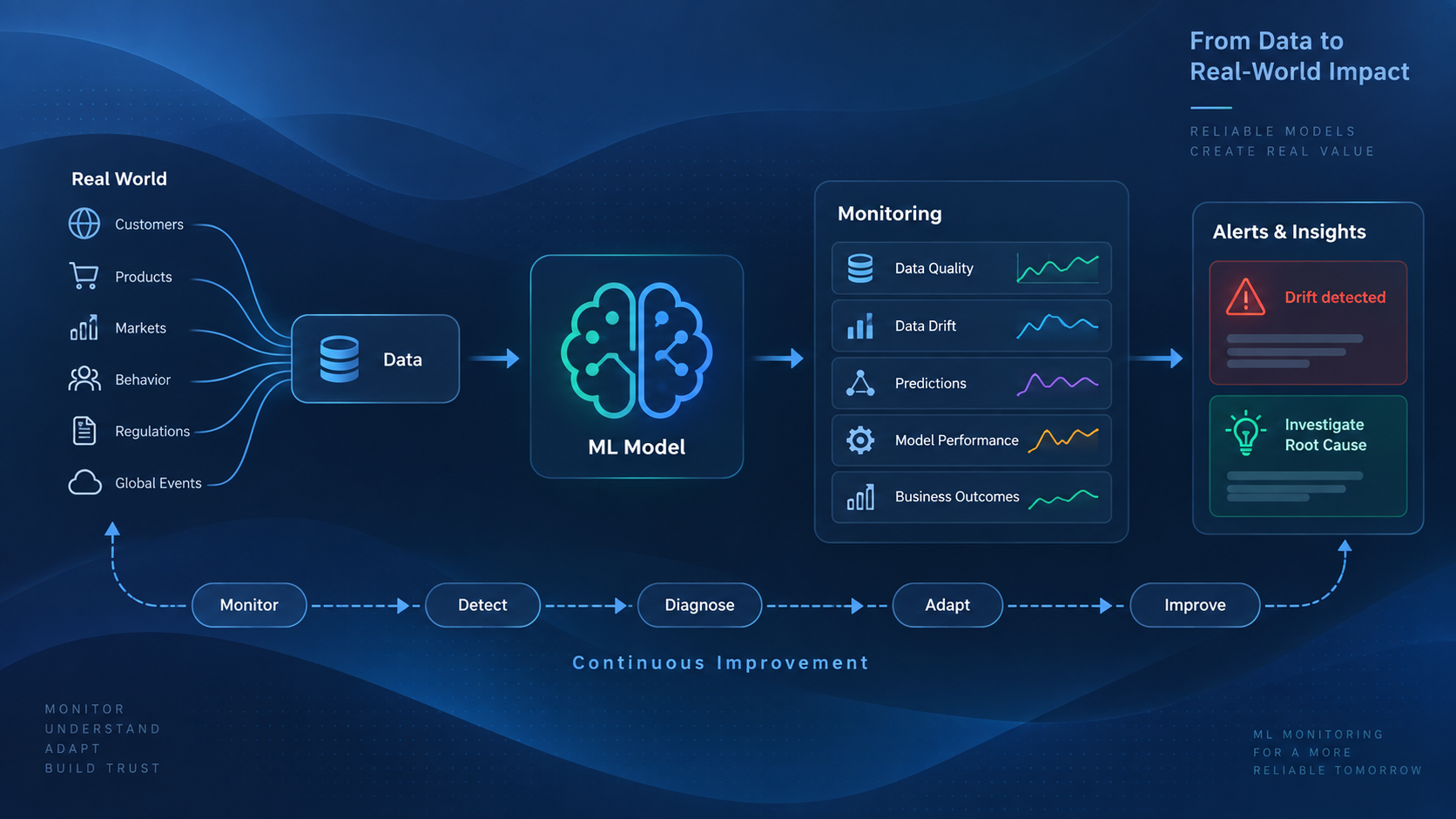
<p>Machine learning models do not remain reliable simply because they performed well during development. Once deployed, models operate in environments that continuously change: customer behavior evolves, markets shift, fraudsters adapt, products change, and data pipelines can fail. Without proper monitoring, an ML system can continue generating predictions while its quality silently deteriorates.</p>
<p>This course introduces the principles and practices required to monitor machine learning systems in production. You will learn how to distinguish infrastructure failures, data quality problems, training-serving skew, data drift, and different forms of model drift, including covariate shift, label shift, and concept drift. You will also explore why model performance can degrade even when infrastructure and traditional data drift metrics appear healthy.</p>
<p>You will also work with observability tools such as Prometheus and Grafana and explore machine-learning-specific monitoring frameworks. By the end of the course, you will be able to design a monitoring strategy for production ML systems, interpret monitoring signals, identify potential causes of degradation, and determine appropriate remediation strategies instead of automatically retraining a model whenever drift is detected.</p>
Requirements
<p>Students should have a basic understanding of machine learning concepts and the typical lifecycle of an ML model, including data preparation, model training, evaluation, and deployment.</p>
<p>Basic Python programming skills are recommended, including familiarity with common data science libraries such as pandas and scikit-learn. Students should also be comfortable working with data, interpreting basic statistical and model evaluation metrics, and reading Python code.</p>
<p>Some familiarity with APIs, Docker, or cloud-based ML systems is helpful but not required. Experience with monitoring or observability tools such as Prometheus and Grafana is not required, as these concepts and tools will be introduced throughout the course.</p>
What web browser should I use?
The Open edX platform works best with current versions of Chrome, Edge, Firefox, or Safari.
See our list of supported browsers for the most up-to-date information.