
Factored
Agentic Coding
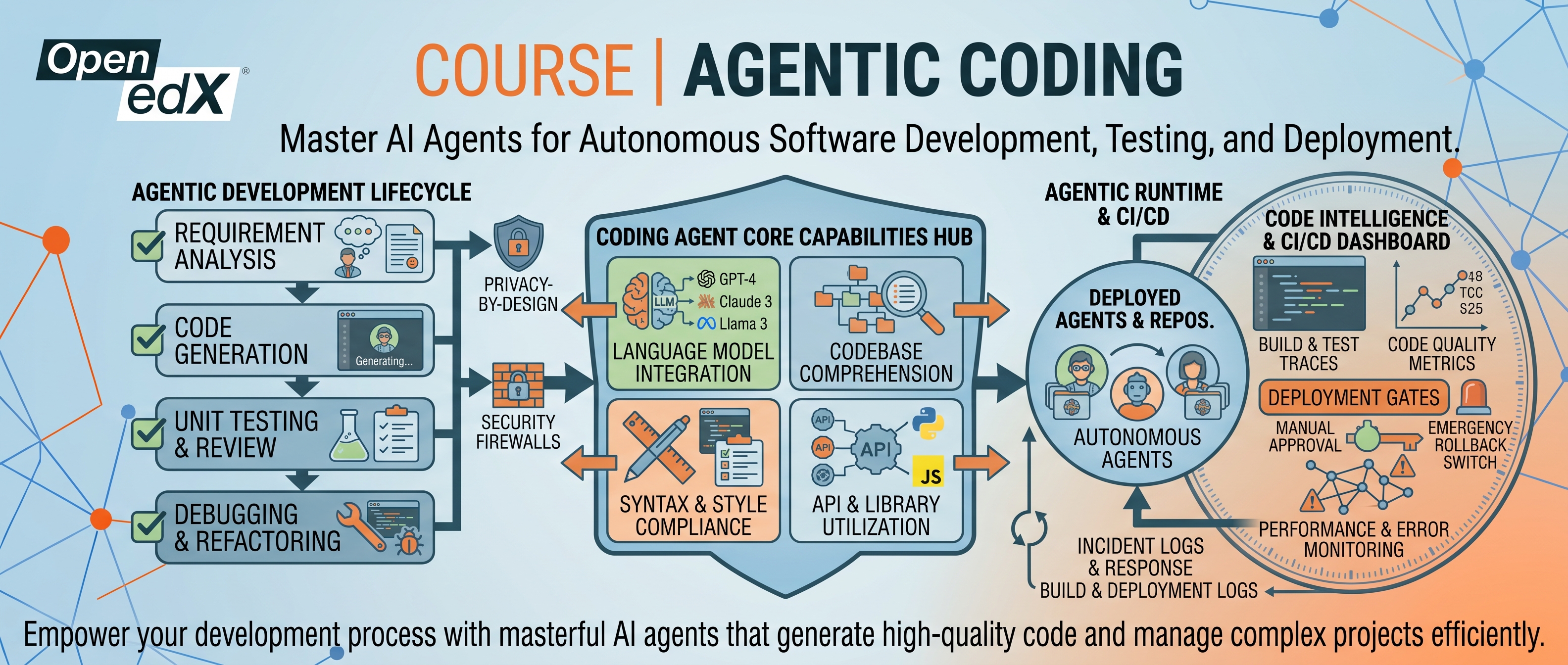
Direct AI coding agents through real multi-step work: explore, plan, verify, extend with subagents, skills, and hooks, write specs agents can execute, and review what they produce.
About This Course
Agentic Coding is for engineers who already write software comfortably and want to work well with AI coding agents: tools that read a repository, plan a change, edit files, run tests, and fix what breaks. It moves you from using AI as autocomplete or a chat window to directing an agent through real multi-step work, while staying accountable for everything it produces.
Each subsection opens with a free external course, video, or recording from DeepLearning.AI, Anthropic, Google Cloud, or a Factored session. Original deep dives follow and go further, connecting the material, explaining trade-offs, and showing how the practices apply to Factored projects. Claude Code is the main tool throughout, and the practices transfer to other agents.
What You Will Learn
The first half of the course builds your understanding and your core workflow. You will learn what separates autocomplete, chat assistants, and agents, how an agent loop is built from a model, tools, and a harness that manages permissions and context, and how the main coding agents on the market differ in where they run and how you steer them. You will then practice the explore, plan, code, and commit workflow in Claude Code, learn to give the agent a way to verify its own work, manage the context window and memory files such as CLAUDE.md, and recognize when to redirect an agent or take back control, finishing with the hands-on Claude Code workshop.
The second half extends and ships that work. You will delegate to subagents, package reusable workflows as agent skills, and enforce rules with hooks, permission modes, and headless runs. You will write specifications and acceptance criteria that an agent can execute. Finally, you will review agent-written code for the failure patterns agents typically produce, check it for security issues, and require evidence before approving a change.
Who This Course Is For
This course is for software, data, and AI engineers in the Jed-AI Academy. It assumes working proficiency in Python, everyday use of git, comfort in a terminal, and the foundations from the earlier Jed-AI courses. It does not assume any prior experience with Claude Code or other coding agents; every agent concept is taught before it is used.
How the Course Is Structured
A Welcome section covers orientation, prerequisites, how to request Claude Code access, and where to get help. Section 1, From Autocomplete to Agents, covers what agentic coding is and the tooling landscape. Section 2, Working Effectively with Claude Code, covers the core workflow, context and memory, iterating with an agent, and the hands-on workshop. Section 3, Extending the Agent, covers subagents, agent skills, and long-running and team-wide sessions. Section 4, Spec-Driven Development, covers writing specs that coding agents can execute. Section 5, Reviewing AI-Generated Code, covers review fundamentals, security review, and evidence and ownership. Each section ends with a short Section Check.
Time Commitment and Completion
The course is designed to be completed over one week of the program. External courses list their own lengths on their pages, and the hands-on material is worth taking slowly with a terminal open. Open edX tracks your progress automatically as you view units and submit the Section Checks, which you can retry.