Factored
Agentic Systems
Design, orchestrate, constrain, and harness AI agents with LangGraph and a second framework, from architecture choices to long-running reliability.
About This Course
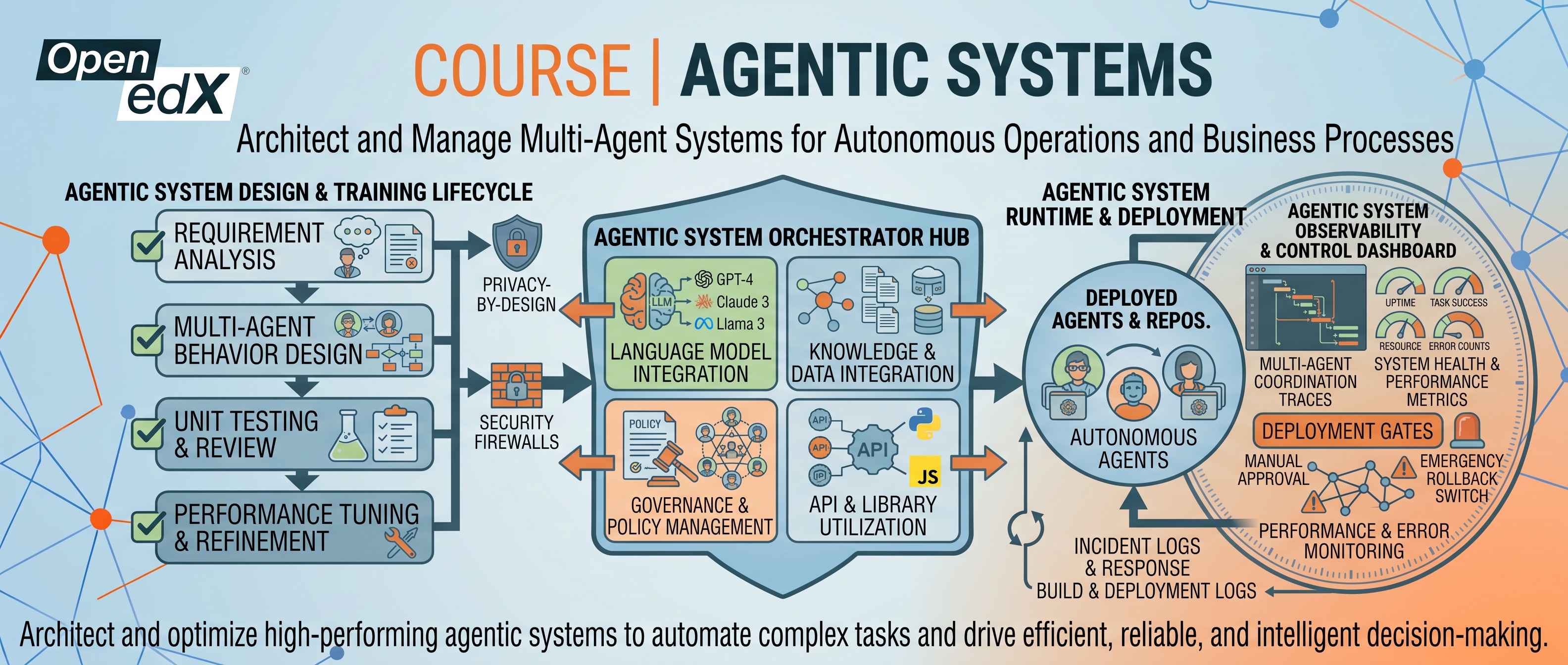
Agentic Systems is the Week 5 course of the Jed-AI SWE Boosting Program. It is for engineers who can already call a model through an API, write structured prompts, and connect tools with MCP, and who now need to build agents: systems in which the model chooses its own next step. It moves you from single model calls to agents that are architected deliberately, orchestrated with explicit state, kept in bounds by code, fed the right context, and supported by a harness that lets them work reliably across many sessions.
Each subsection opens with a free external course, guide, or article from the teams that build these tools, including LangChain Academy, DeepLearning.AI, Anthropic, Hugging Face, and the Prompting Guide, as a broad on-ramp. It then continues with original deep dives written for this program that go past where the external material stops, connect the topics to one another, and point ahead to the later SWJedAI courses that build on them.
What You'll Learn
In the first half of the course you learn to decide when an agent is the right tool at all, using the distinction between workflows and agents and the five common workflow patterns, and to choose between ReAct, Plan-and-Execute, ReWOO, and LLMCompiler based on how predictable a task is. You then learn LangGraph in depth: typed state, nodes, edges, and reducers; checkpointers, threads, and time travel; long-term memory in a store, organized as semantic, episodic, and procedural memory; and parallel branches, map-reduce, and subgraphs. To avoid depending on a single vendor, you also build with smolagents from Hugging Face, compare LangGraph with Pydantic AI, the OpenAI Agents SDK, and Google ADK, and learn habits that keep an agent portable across frameworks.
In the second half you learn to keep agents in bounds with human approval gates built on LangGraph interrupts, including the re-execution pitfall, the same pattern in the OpenAI Agents SDK and Pydantic AI, deterministic guardrails enforced in code with least privilege and sandboxing, and validation of structured agent outputs with Pydantic. You learn context engineering: why context rot makes every token count, how compaction, structured notes, and sub-agents support long tasks, and how the write, select, compress, and isolate strategies map to real features. Finally, you learn harness engineering: the repository as system of record, instruction files that reveal detail on demand, initializer and worker agents, leaving a clean state after every session, and Deep Agents as a ready-made harness. An optional section covers fine-tuning a small open model for tool calling and serving open models for agents with vLLM.
Who This Course Is For
This course is for software engineers in the SWE Boosting Program who have completed the earlier courses in the sequence, in particular LLM API and Orchestration and MCP. It assumes comfortable Python with type hints, experience calling a model API with tools and structured outputs, and basic Git. It does not assume any prior experience building agents, using LangGraph, or working with any agent framework; every agent concept is taught before it is used or tested.
How the Course Is Structured
A Welcome section covers orientation, setup, how to request model access, and how this course connects to the rest of the sequence. Section 1, Agent Architectures, covers workflows versus agents and the ReAct and planning families. Section 2, Orchestrating Agents with LangGraph, covers foundations, state and memory, parallelism and subgraphs, and a second framework to avoid lock-in. Section 3, Keeping Agents in Bounds, covers human-in-the-loop approval, deterministic guardrails, and structured outputs with validation. Section 4, Context Engineering, covers context as a finite resource and the four context strategies. Section 5, Harness Engineering, covers what a harness is, long-running agents and clean state, Deep Agents, and a course wrap-up. Sections 1 to 5 each include a short Section Check at the end of their teaching units. Section 6 is optional enrichment on fine-tuning models for tool calling and serving open models for agents.
Time Commitment and Completion
The program calendar allots about 10.5 hours to the mandatory material and about 4 hours to the optional material. The LangGraph course is the largest single piece, at roughly 6 hours of video plus notebooks, and is taken in stages across Section 2; its human-in-the-loop module is replaced by an updated walkthrough in Section 3. You complete the course by working through every unit in Sections 1 to 5, including the external courses they link to, and submitting the five Section Checks.