
Factored
MCP
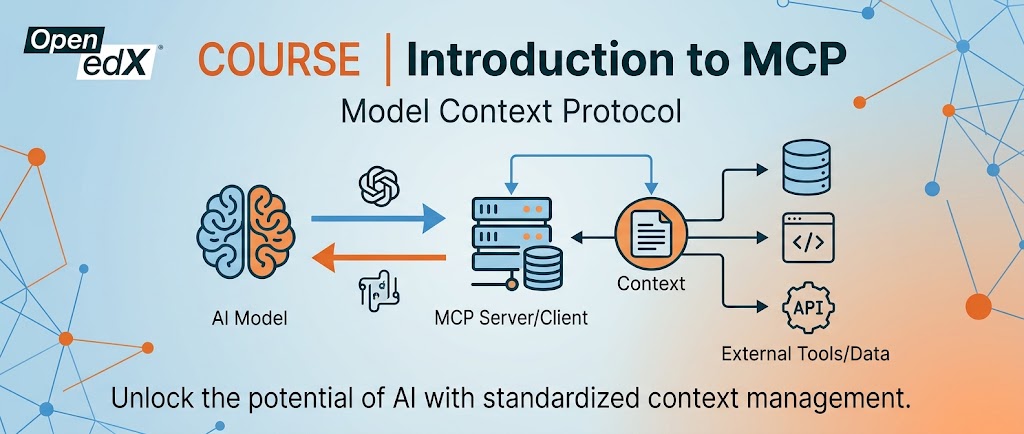
# MCP Fundamentals
This course is built for engineers who want a working understanding of the Model Context Protocol, from the concepts through building a first server. It moves past treating MCP as a buzzword and into the specifics: what problem it actually solves, how the host, client, and server pieces relate to each other, and what it takes to stand up a server that exposes tools, resources, and prompts.
Each subsection in this course pairs a free, self-paced course from Anthropic or the official Model Context Protocol project with original material built specifically for this program. The vendor courses give you the grounding the protocol's own maintainers consider essential. The original lessons connect those pieces together and go one level deeper, covering the participant model, the primitive comparison, and debugging a real server, that sit just past where the vendor material stops.
## What You'll Learn
The course opens with the foundations everything else depends on: why MCP exists in the first place, how a host, client, and server relate to one another, and how the protocol splits into a data layer and a transport layer so the same server behavior works whether it is reached locally or over a network. From there it covers the three primitives every MCP server exposes, tools, resources, and prompts, and why MCP deliberately puts a different party in control of each one.
The second half turns from concepts to practice. You'll follow the official quickstart to build a working MCP server exposing real tools, then extend that same server with resources and prompts, and learn to debug it directly with the MCP Inspector before wiring it into a client. The course closes with a short, non-technical look at why a server that works on your own machine still needs hardening before it is safe to run in production, setting up the advanced course that follows this one.
## Who This Course Is For
This course is aimed at AI engineers and backend engineers who want to connect Claude, or any MCP-compatible client, to external tools and data sources without writing custom integration code for every service. It assumes basic Python, a working sense of asynchronous programming patterns, and comfort with the general idea of client-server APIs. No prior MCP experience is assumed.
## How the Course Is Structured
The course is organized into two sections.
The first covers the foundations of the protocol:
- An introduction to MCP from Anthropic Academy
- The host, client, and server participant model, and the data layer versus transport layer split
- Tools, resources, and prompts compared, and who controls each one
- The official MCP base protocol specification
- Why MCP exists, and the integration problem it replaces
The second covers building a server end to end:
- The official quickstart for building an MCP server
- Extending a server with resources and prompts
- Debugging with the MCP Inspector
- A preview of why MCP servers need hardening before production
Each subsection opens with the relevant vendor course as a starting point, followed by original lessons that connect the pieces and go deeper where it matters.
## Pacing and Completion
This course is self-paced: work through the sections in order, at whatever speed fits your schedule, with no fixed deadline. Completing it means finishing the linked vendor courses alongside the original lessons in each subsection, and coming away able to explain how MCP works and build a server of your own.