
Factored
Advance MCP
Go past MCP Fundamentals into sampling, roots, transports at scale, multi-agent systems, reliability, performance, and security for production.
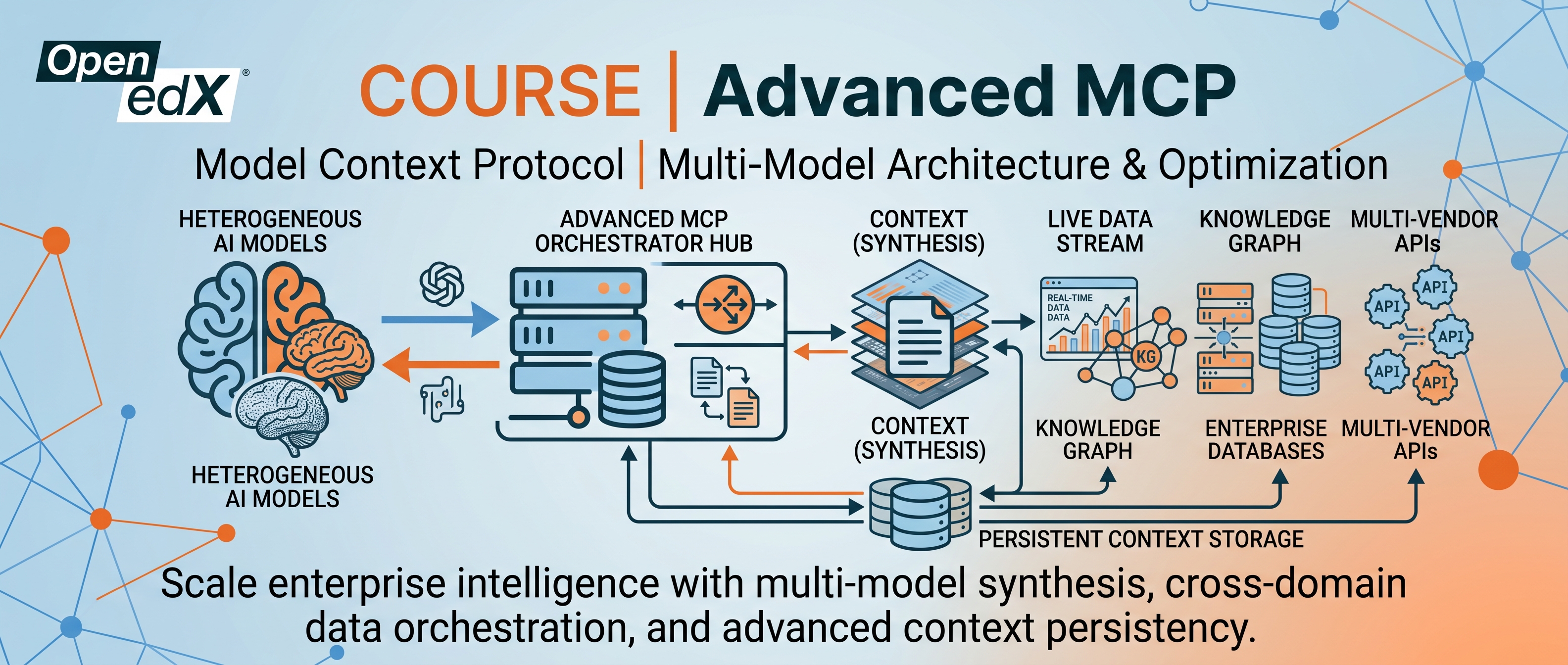
This course is for anyone who has completed the foundational Model Context Protocol course and built a working server, and is ready to move past a single client talking to a single server into the primitives, architectures, and operating concerns a production MCP deployment actually needs. It pairs a verified external vendor course, Anthropic Academy's Model Context Protocol: Advanced Topics, with original material that goes further than that course does on its own, and adds coverage the vendor course does not touch at all: architecture at scale, multi-agent systems, reliability and performance, and security and governance.
The first half of the course stays close to the protocol itself. It covers sampling, where a server asks the client's model for help and the client stays in control of whether that happens; log and progress notifications and roots, which let a server report on itself and learn its own boundaries; and the STDIO and StreamableHTTP transports, including what it takes to carry session state once a server is more than a single process. The second half moves outward from the protocol to how it is actually run in practice: gateway and federation patterns for an estate of many servers, how a multi-agent research system coordinates specialized agents behind an orchestrator using a ReAct loop, the distributed-systems patterns that keep a deployment reliable and fast, and the security practices that keep both the servers you build and the third-party servers you connect to safe to use.
This course assumes the foundational MCP course, working experience with Python and async programming, familiarity with JSON and HTTP, and basic knowledge of Server-Sent Events. It does not assume you have built a multi-agent system, run a server in production, or dealt with an enterprise security review before; those are exactly what this course teaches. It is built for engineers who are about to take an MCP server past a single laptop and a single user.
The course is organized into seven sections. Section 1 orients you and covers access to the tools you will need. Section 2 covers the remaining MCP primitives: sampling, notifications, roots, and both transports. Section 3 moves to architecture at scale: gateway and federation patterns and the challenges of enterprise deployment. Section 4 covers building multi-agent systems on top of MCP. Section 5 covers designing for failure and optimizing performance. Section 6 covers security and governance, for both the servers you build and the third-party servers you connect to. Section 7 closes with a recap tying every section back together.
This course has no capstone project of its own. The federated multi-agent MCP platform capstone that closes out the curriculum's MCP track is assigned as part of the foundational MCP course; this course is what prepares you to build it well. Each subsection opens with a verified external resource before moving into original material, so budget time for both, not just the deep dives. Progress is tracked automatically as you view units, watch any linked material, and complete the ungraded practice quizzes at the end of each section.