
Factored
AI Governance & Security
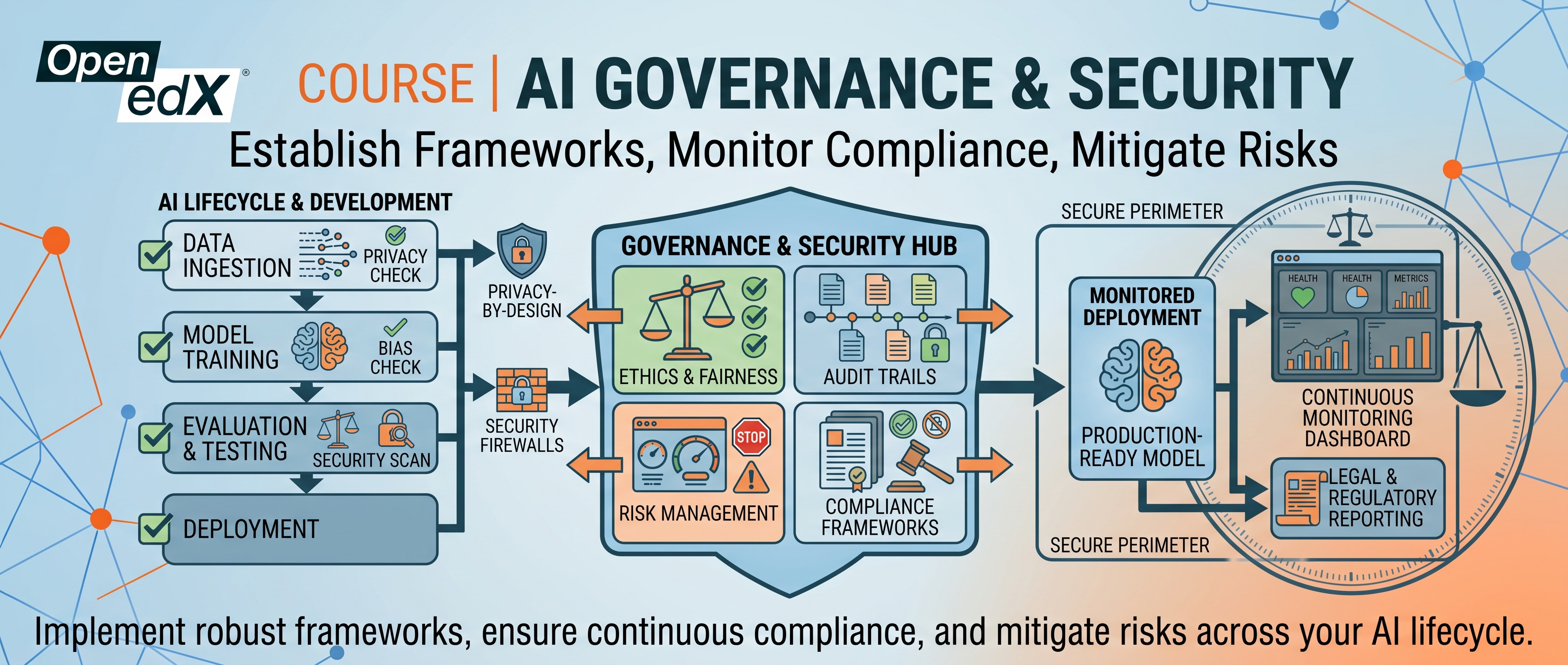
A practical, vendor-neutral course on securing AI agents: the OWASP Top 10 for Agentic Applications, prompt injection and jailbreaking, data handling risks, identity and supply chain security, and building a real agent governance practice.
About This Course
Agents that browse, call tools, write code, and take actions on their own behalf inherit an attack surface far larger than a chatbot that only answers questions. This course moves you from being able to build and deploy an agent to being able to secure and govern one: to reason about what actually goes wrong in an agentic system, and to build the mitigation and governance program that keeps it accountable once it is live.
Selected subsections open with a verified, free external video or vendor course, drawn from sources including DeepLearning.AI and the OWASP GenAI Security Project, that introduces the topic at an entry level. Every subsection then continues with original lecture material that goes past where that outside resource stops, written specifically against the OWASP Top 10 for Agentic Applications and the current agent security literature. Every lecture simplifies dense source material into a clear read, and links out to the original OWASP and vendor guidance for anyone who wants the full technical depth.
What You Will Learn
The first half of the course builds the vocabulary and the ten-risk map. It opens with why an agent's ability to act, not just answer, expands the traditional application attack surface, and introduces least agency, the principle that runs through nearly every mitigation taught afterward. From there it works through all ten risks in the OWASP Top 10 for Agentic Applications, from goal hijacking and tool misuse through cascading failures and rogue agents, and then goes deep on prompt injection and jailbreaking: how these attacks actually work, and the layered defenses, including the Rule of Two, used against them.
The second half moves from individual risks to the practice of running a secure agent program. It covers data handling risks specific to agentic systems, improper output handling and RAG-specific data leakage, then agent identity, access control, and supply chain security, including model provenance and third-party tool vetting. From there it turns to the four areas of AI red teaming and how they validate whether an organization's mitigations actually hold up, and closes by building an agent governance practice around four pillars, visibility, policy, accountability, and continuous assurance, then scaling it to a fleet of agents and connecting it to external standards, risk tiering, and incident response. The course ends with a capstone Mission exercise, a full-stack red team scenario that asks you to apply what you have learned to attacking and defending an agentic system, submitted as a written report for staff review.
Who This Course Is For
This course assumes you are already comfortable building and deploying an agent that calls tools and reasons over multiple steps. It is aimed at engineers and practitioners who can already build an agent and now need to secure and govern one, not at learners new to agents themselves. If you have not yet completed the earlier Jed-AI Academy tiers covering agent building and evaluation, do that first: the security concepts here build directly on how agents plan, call tools, and act. No prior background in security, OWASP frameworks, or governance practice is assumed; those are taught from the ground up.
How the Course Is Structured
The course opens with a short Welcome section that orients you to the material and points you to the course forum for questions. From there, eight sections run in sequence: Why Agent Security Is Different, the OWASP Agentic AI Top 10 in two parts, Prompt Injection and Jailbreaking, Data Handling Risks, Supply Chain and Identity Risks, Red Teaming Agentic Systems, and Building a Governance Practice. Those eight sections break down into 24 subsections, and most subsections run two to four units: an opening video or vendor course where one exists, one or more original deep-dive lectures, and a Section Check at the end of each section that tests the whole section. The course ends with a Mission section, a single capstone exercise that pulls the whole course together.
Time Commitment and Completion
This is a pure-lecture course with no hands-on labs: each subsection is a short lecture, and each section closes with a Section Check, and select subsections add a linked video or external course for a different angle on the same material. Because the course runs on an instructor-paced schedule, work through the sections in order and complete each subsection's check before moving on. Completion is tracked automatically as you view each lecture and submit each check; the Mission section's capstone report is reviewed by course staff separately.